Mixed-unit projects are normal. Drawings come from one country, materials are specified in another, the site team works in whatever they grew up with, and somewhere between the specification and the cut, a number changes meaning. The result is a batch of components that are consistently two percent wrong and a conversation nobody wants to have.
Where the errors come from
Rarely from arithmetic. Almost always from one of these:
- Ambiguous units. A “ton” may be 1,000 kg, 2,240 lb or 2,000 lb depending on where the document originated. A “gallon” differs by about 20% between the US and imperial definitions.
- Rounding at the wrong point. Converting, rounding, then multiplying by a quantity propagates the rounding error across every unit. Convert last, round last.
- Precision inflation. A measurement taken to the nearest centimetre does not become more accurate by being expressed to four decimal places in inches. It just looks authoritative.
- Derived units. Area and volume scale by the square and cube of the linear factor. The commonest serious error on a site is applying a linear conversion factor to an area.
- Pressure and load. psi, kPa, bar and kg/cm² are routinely treated as interchangeable in informal notes. They are not.
The rules that prevent most of it
- Pick one working unit system per project and convert everything into it once, at the document stage, not repeatedly at the point of use.
- Record the original alongside the converted value. “2,400 mm (8 ft)” lets anyone audit the conversion later.
- Never convert twice. Every round trip loses precision. Go back to the source value each time.
- Carry full precision through the calculation and round only the final answer to the tolerance that actually applies.
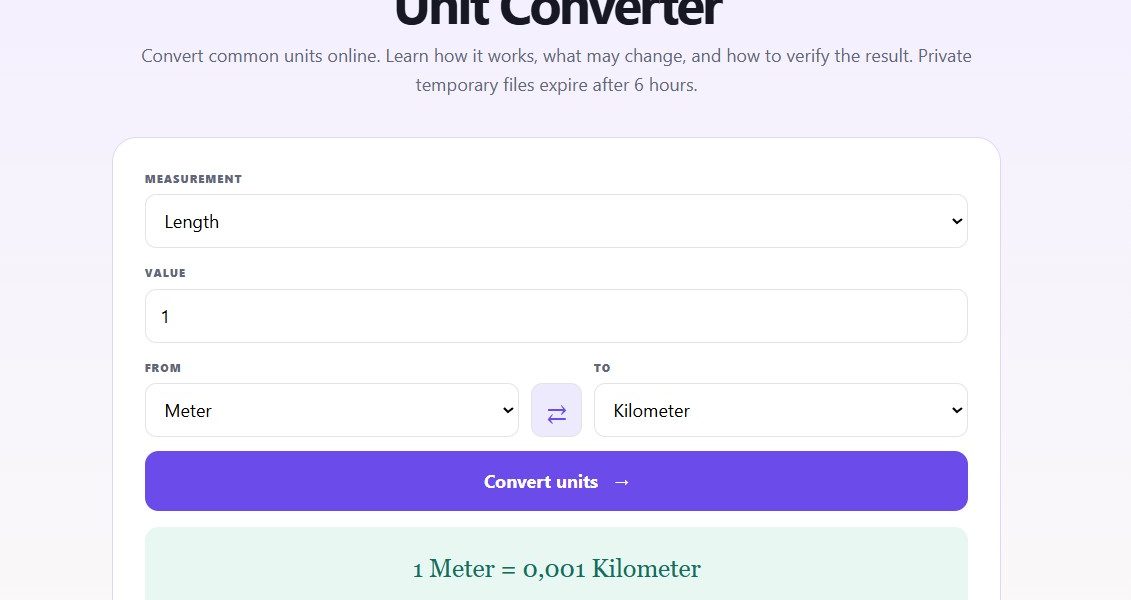
For anything non-routine — pressure, torque, thermal values, load per area — use a unit converter rather than a remembered factor. Remembered factors are where the ton, the gallon and the psi problems live.
Tolerance is the number that actually matters
| Work | Typical tolerance | Sensible precision |
|---|---|---|
| Earthworks | ±25 mm | Whole centimetres |
| Concrete formwork | ±6 mm | Millimetres |
| Structural steel | ±3 mm | Millimetres |
| Joinery and fit-out | ±1 mm | Millimetres |
| Machined components | ±0.05 mm | Hundredths |
Quoting a converted dimension to a precision finer than the tolerance is not extra care — it obscures which digits are real. Round to the tolerance and state it.
The documentation side
Conversion errors also arrive through the paperwork. Site photographs from phones are enormous and get compressed by email in ways that destroy the detail you took them for; running them through an image compressor at a controlled setting keeps them legible while making them sendable.
Drawings and specifications arrive in whatever the originator used — a spreadsheet of quantities, a document of specifications, a set of images. Bringing them to one format with a PDF converter before distribution means the site team works from one file rather than six, and the version everyone holds is the version that was checked.
Two conversions that are always worth double-checking
Rebar and fixings. Diameters are specified in millimetres in most of the world and in fractional inches or numbered sizes in the United States, and the numbering system does not correspond to any dimension directly. A #4 bar is not 4 of anything obvious. Convert from a published table, never by estimating from the number.
Concrete strength. A cube-tested value and a cylinder-tested value for the same concrete are not the same number, and converting the units without converting the test basis produces a specification that reads correctly and means something different. Note which standard the source value used.
The check worth building in
Before anything is cut, ordered or poured, one person converts the critical dimensions back to the source units independently and compares. It takes ten minutes. Set against a batch of incorrectly sized components, it is the cheapest quality control on the project.
Author